
Brian’s Bench
A lot of people think building a business means having all the answers.
In my experience, it’s just the opposite.
It’s a long series of figuring out what doesn’t work, fixing it, and then finding out your new solution has its own problems. Then you fix those.
That’s been the story of Stallion Coatings from day one.
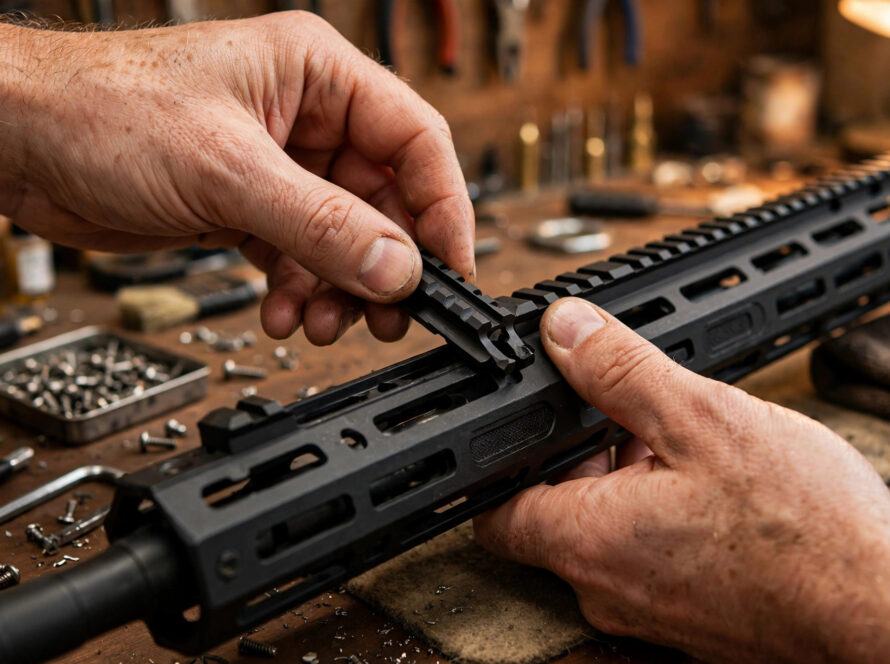
One example that comes to mind is a fixture I built for my laser.
When I first started engraving Rail Armor, every piece was clamped in a vise and aligned by hand. Every. Single. Time.
Was it slow?
Yep.
Did it work?
Also yep.
When you’re a one-man shop, “works” is sometimes all you’ve got. You make the best parts you can with the tools you have, and you keep moving forward.
As Rail Armor became more popular, I knew I needed something more repeatable. I didn’t want to spend time chasing alignment when I could be engraving.
My brother-in-law Jerry is pretty handy with CAD software, so he designed a fixture that I could print on a 3D printer. I ran it in PLA, bolted it to the laser table, and just like that every part dropped into exactly the same place.
It was one of those moments where you wonder why you didn’t do it sooner.
For standard engraving, it was fantastic.
Then I started experimenting with 3D depth engraving.
If you’ve never seen depth engraving, the laser doesn’t just mark the surface. It makes pass after pass, removing material until the engraving actually has depth you can feel. It creates a completely different look, but it also creates a lot more heat.
Turns out…
PLA doesn’t appreciate that.
The fixture didn’t suddenly melt into a puddle like something out of a movie. It was more subtle than that.
The aluminum parts slowly transferred heat into the fixture until the plastic began to soften. A fixture that had been perfectly accurate started losing just enough precision to become a problem.
Not by much.
But in this business, “close enough” isn’t good enough.
So the plastic fixture came off the table.
My friend Mike Cramer at 19C Tactical helped machine a new fixture out of aluminum. Same idea. Same location. Same repeatability.
Different material.
Problem solved.
At least until I figure out a better way.
That’s become a running joke around here.
If you’ve spent much time talking with me, you’ve probably heard me say, “It works… until I figure out a better way.”
I don’t change things just to change them.
I change them because every improvement, no matter how small, makes the next project a little better than the last one.
Sometimes it’s a fixture.
Sometimes it’s the order I spray camouflage colors.
Sometimes it’s how I label stencils so I don’t have to stop and think halfway through a complicated pattern.
None of those changes are exciting by themselves.
Most customers will never know they happened.
But they’ll notice the end result.
The older I get, the more I believe quality isn’t about one big breakthrough. It’s hundreds of little improvements that most people never see.
That’s probably what you’ll find here in Brian’s Bench.
Not marketing.
Not lectures.
Just stories from the shop about what worked, what didn’t, and what I learned along the way.
If one of those stories helps another builder avoid a mistake, or gives a customer a better understanding of what goes into the work, then it was worth writing.
Shop Notes
- Every process gets questioned eventually.
- “Good enough” has a short lifespan.
- The smallest improvements often make the biggest difference over time.
What I Learned
The best shops aren’t built because somebody got everything right the first time. They’re built because somebody kept asking, “How can I make this better?”
Thanks for spending a little time at Brian’s Bench. Next time, I’ll talk about something that surprises a lot of people—the finish on your firearm starts long before the spray gun ever comes out.